

Child Development
How We Encourage Independence in the Early Years (And Why It Starts Earlier Than You Think)
Written by Jeanne, Owner & Director at Blooming Years Nursery

Independence isn't something children suddenly develop when they start school. It grows slowly, in small moments, from the very earliest months. I've been working in early years for long enough to know that the families who tend to worry most about this are often the ones whose children are thriving, because they're paying close attention.
At Blooming Years, one of our three core principles is empowerment: teaching children how to think, not what to think. That phrase shapes a lot of what we do every day, across all six of our nurseries in South and West London.
What independence actually looks like at this age
When I talk to parents about independence, especially those with younger children, I often get a slightly puzzled look. Their child is two. Or eighteen months. What does independence even mean at that age?
The honest answer is: quite a lot. We're not talking about children fending for themselves. We're talking about the small, meaningful moments where a child discovers they can do something without help. Choosing which book to look at. Attempting to put on their own shoes. Pouring their own water at lunchtime. Deciding which mark-making tool to pick up.
These moments matter because they build something deeper than a skill. They build the feeling of being capable. And that feeling, once a child has it, tends to grow.
How we create the conditions for it
The environment does a lot of the work. In our rooms, resources are stored at child height. Children can access what they need without asking an adult. That might sound like a small thing, but we find it changes the whole atmosphere. Children become initiators rather than waiters.
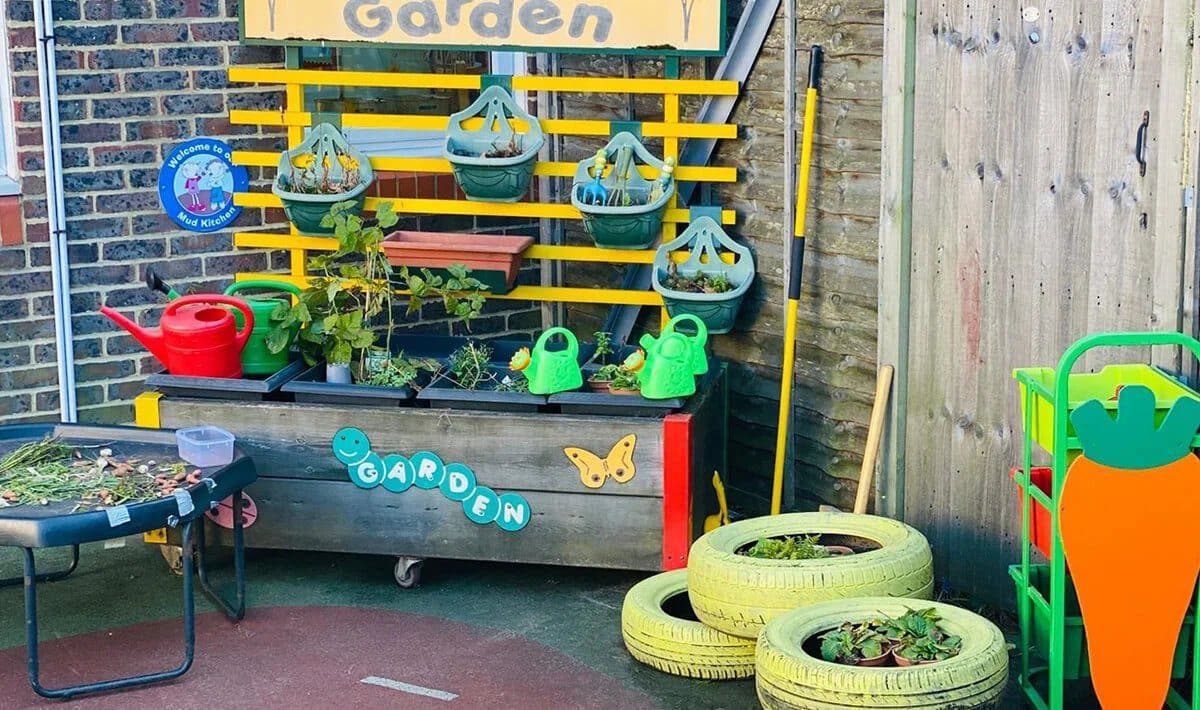
Outdoors, we see this even more clearly. Time outside every day, in all weathers, gives children the chance to take small physical risks, to try things and sometimes not manage them, and to try again. Our mud kitchens are a good example. There is no right way to use a mud kitchen. Children have to make decisions, experiment, and work things out themselves or alongside their peers.
Mealtimes are another place where independence develops quietly. Our kitchen team prepares fresh meals on-site each day, and we encourage children to serve themselves where appropriate, to express what they do and don't want, and to experience the social rhythm of eating together. These habits build confidence in ways that go well beyond food.
The adult role: stepping back without stepping away
This is the part that takes the most skill, and I say that with genuine respect for our staff. The temptation when a child is struggling is to step in. To help. To finish the zip, resolve the disagreement, hand over the piece of puzzle they can't quite find.
We train our teams to pause before they intervene. To ask: is this child in difficulty, or are they in the productive struggle that leads to learning? There is a real difference, and getting it right takes experience and attentiveness.
We also think carefully about the language we use. Rather than "well done" for everything, we try to be specific. "You kept trying even when it was tricky" is more useful to a child than a general thumbs-up, because it helps them understand what they actually did.
This approach connects to the EYFS statutory framework, which sets out clearly how practitioners should support children's personal, social, and emotional development, including their growing independence and self-regulation.
What families can do at home
Parents often ask us how to carry this through at home, which is a conversation I always enjoy. A few things we suggest:
- Give children time. Independence takes longer than doing it yourself. Building that time into the morning routine, for example, means it becomes normal rather than stressful.
- Offer choices within boundaries. "Would you like the red cup or the blue cup?" gives a child real agency without creating chaos.
- Let them make small mistakes. A child who spills something and helps to wipe it up has learned something. A child who never spills anything hasn't been given the chance.
- Notice effort, not just outcome. If a child tries to do something independently and doesn't quite manage it, that attempt deserves acknowledgement.
We share more of this kind of thinking in our termly one-to-one conversations with families, and our staff are always happy to chat through what we're seeing day to day.
Across our nurseries
We have families joining us from across Hammersmith and Fulham, Lambeth, Croydon, and Merton, and while each community has its own feel, the questions parents ask about independence are remarkably similar. The instinct to protect, to help, to make things easier for our children is universal. What we try to offer is the reassurance that stepping back, thoughtfully and with care, is one of the most supportive things an adult can do.
If you'd like to see how we approach this in practice, we'd love to show you around. You can book a show-around at any of our six sites across South and West London, and meet the team who work with your child every day.
Come and see us for yourself
Book a relaxed tour of Blooming Years Nursery and meet our team.
Book a tourOther guides you might like

Child Development
Why Routine Matters for Toddlers (And What We See at Nursery Every Day)
Routine gives toddlers something they crave but can't always ask for: predictability. Here's what we observe every day at Blooming Years, and how you can make routine work at home too.
Child Development
Why Messy Play Matters More Than You Might Think
Messy play can feel chaotic from the outside, but what we see every day at Blooming Years tells a different story. Here's why getting hands dirty is one of the most valuable things young children can do.

Child Development
What Mixed-Age Learning Actually Looks Like in a Nursery Setting
Mixed-age groupings are a deliberate choice at Blooming Years, not just a logistical one. Here's what we observe day to day, and why it matters for young children's development.
Frequently asked questions
At what age should children start developing independence, and how do you support this at nursery?
Independence begins developing from the earliest months, long before children can articulate it. At Blooming Years we create environments where children access resources themselves, make choices, and experience manageable challenges. We work with babies and toddlers as well as pre-schoolers, supporting independence at every stage in age-appropriate ways.
How do your staff know when to help a child and when to let them work something out themselves?
It's one of the most important judgements in early years practice. We train our teams to distinguish between a child who is stuck and needs support, and a child who is in the productive struggle that builds confidence. We pause before intervening, and when we do step in, we try to prompt rather than solve.
Do you keep parents informed about how their child is developing independence and other milestones?
Yes, parents receive daily updates on their child's activities, mood, meals, and sleep. We also hold termly one-to-one conversations with families to discuss their child's development in more depth. If you'd like to see our nursery and meet the team before enrolling, you're very welcome to book a show-around.
What funding is available to help with the cost of nursery at Blooming Years?
We accept 15-hour and 30-hour government funding. Every 3 and 4 year old is entitled to 15 hours per week regardless of parental income or work status. Eligible working families can access up to 30 hours, now available from 9 months old. Visit our fees and funding page or check your eligibility at childcarechoices.gov.uk.