

Child Development
How Nursery Helps Young Children Build Social Skills That Last
Written by Jeanne, Owner & Director at Blooming Years Nursery

Social skills don't arrive fully formed. They develop slowly, through hundreds of small moments across the day. A child who learns to wait for their turn at the water tray, who offers a friend a tissue, who notices that someone is sitting alone at snack time: these are not small things. They are the foundations of how that child will navigate relationships for the rest of their life.
At Blooming Years, we work with children aged 3 months to 5 years across our six settings in South and West London, from Croydon and Lambeth through to Hammersmith and Fulham and Merton. And across all of those communities, one thing is consistent: parents care deeply about whether their child is developing the social confidence to thrive.
So here is what we actually see, and what we do to support it.
What social development looks like in the early years
It helps to know what is typical at different ages, because parents sometimes worry unnecessarily, and sometimes miss things worth noticing.
Babies as young as three or four months begin responding to faces and voices. This is the very beginning of social learning. Toddlers between one and two years often play alongside other children rather than with them. This is called parallel play, and it is completely appropriate. It is not a sign of shyness or difficulty; it is a stage.
By the time children are approaching three and four, we start to see more genuine cooperative play: negotiating roles, sharing ideas, resolving small disagreements. This is where a nursery environment really comes into its own, because these skills need other children to practise on.
How we support social skills day to day
We do not run dedicated "social skills sessions" and then expect children to absorb the lessons. It does not work that way. Social learning happens in the moment, throughout the day, in ordinary situations.
Some of the things we find most effective:
- Giving children language for their feelings. When a child is frustrated because someone has taken their toy, our practitioners name what they are seeing. "You look upset. You were using that, weren't you?" This helps children build the vocabulary to express themselves rather than act out.
- Narrating social situations. We talk children through what is happening around them. "Look, Amara is crying. I wonder how she's feeling?" This builds empathy gradually and naturally.
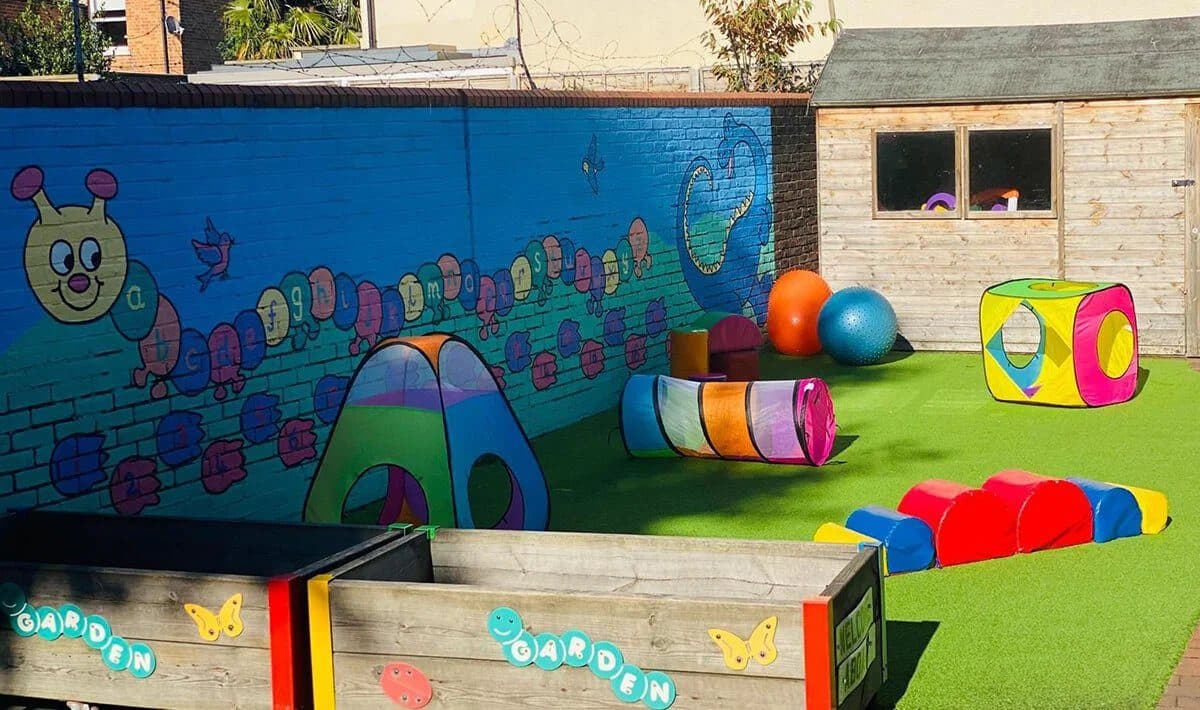
- Creating genuine reasons to cooperate. In our outdoor spaces, children work together to fill the mud kitchen, move things, build structures. These are not contrived exercises. They are real tasks that require real collaboration.
- Resisting the urge to intervene too quickly. We observe a lot before we step in. Children need the opportunity to try to resolve things themselves, to feel the discomfort of disagreement and find their way through it. Our role is to be close enough to support, not so close that we remove the challenge.
- Mealtimes as social practice. Sitting together, passing food, waiting, talking about the day: our on-site cooked lunches give children a daily rhythm of shared experience that many families tell us makes a real difference.
The role of key workers
Every child at Blooming Years has a key worker who gets to know them well, their communication style, their triggers, their particular friendships. This matters for social development because children who feel securely attached to an adult in the setting are far more willing to take the social risks that lead to growth. They will try to make a friend, join a game, speak up, because they know there is a safe base to return to if it does not go well.
Across our settings in Lambeth, Merton, Croydon, and Hammersmith and Fulham, we put a lot of thought into these relationships. They are not incidental to what we do. They are central to it.
What you can do at home
The nursery day is only part of the picture. We often hear from parents that they want to support the same skills at home but are not sure how. A few things that genuinely help:
- Let children experience small social difficulties without immediately solving them. The frustration is part of the learning.
- Play simple games that involve taking turns: board games, card games, anything with a rule or a sequence.
- Talk about how other people might be feeling when you are out together. In a queue, on the bus, watching other children in the park.
- Read together and pause to wonder aloud about what characters might be thinking or feeling.
None of this needs to be formal. The best social learning, at home just as in nursery, happens inside ordinary moments.
Come and see it for yourself
If you would like to see how we support children's social and emotional development across our settings, we would love to show you around. A visit gives you the chance to meet our team, watch the children together, and ask any questions you have. You can book a tour at whichever of our locations suits your family best.
Come and see us for yourself
Book a relaxed tour of Blooming Years Nursery and meet our team.
Book a tourOther guides you might like
Child Development
What Is the EYFS Framework and What Does It Mean for Your Child?
The EYFS framework shapes everything that happens in a nursery, from how staff plan activities to how your child's progress is tracked. Here's what it actually means in practice.

Nutrition
Building Healthy Eating Habits: A Guide to Nutrition for Toddlers
Establishing good eating habits early sets the foundation for lifelong health. We share practical tips for introducing nutritious foods and creating positive mealtimes with your toddler.

School Readiness
School Readiness: Beyond the Academics
School readiness isn't just about knowing your letters and numbers. We explore what truly prepares children for their transition to school, and how nursery helps build these essential foundations.
Frequently asked questions
At what age do children typically start playing with others rather than alongside them?
Most children begin moving from parallel play, where they play near but not with others, into cooperative play somewhere between the ages of three and four. This varies considerably between children. Earlier social play does happen, but it is not a concern if a two-year-old still prefers playing side by side rather than together.
My child is quite shy. Will nursery help, or will they find it overwhelming?
In our experience, many children who seem shy at first grow in confidence gradually once they feel safe in their environment. We settle children slowly, at their own pace, and our key worker model means each child has a consistent adult to anchor to. Shyness rarely prevents a child from forming close friendships; it just means the process takes a little longer.
How does Blooming Years help children with social development during the settling-in period?
Before your child starts, we call families to understand what helps their child feel comfortable. Settling begins with play-and-stay sessions, where your child visits with you present. We increase independent time gradually over roughly two weeks, always following the child's lead. This careful process helps children feel secure enough to start engaging socially with their new peers.
Do you share information about my child's social development with me regularly?
Yes. Parents receive daily updates covering their child's activities, meals, sleep, and emotional wellbeing. We also hold termly one-to-one discussions with families to talk through their child's development in more depth, including how they are getting on socially with other children and with the wider group.